Thanks to canonical tags, duplicate URLs no longer need to cause anxiety. In today’s SEO landscape, if you don’t specify which URL is canonical, search engines like Google will decide for you—potentially impacting your rankings and visibility.
By using canonical tags, you control which URL appears in search results, ensuring a consistent and streamlined user experience. Canonical URLs remain a powerful tool for addressing duplicate content challenges. As Google puts it, “carpe diem on any duplicate content issues!”Canonical tags have been a staple in SEO since their introduction in 2009. However, improper implementation can still cause significant issues, such as diluted rankings and confusion for search engines. Not to worry—this article will walk you through modern best practices for implementing canonical tags correctly. So, let’s jump right into it.
What Are Canonical Tags & Canonical URLs?
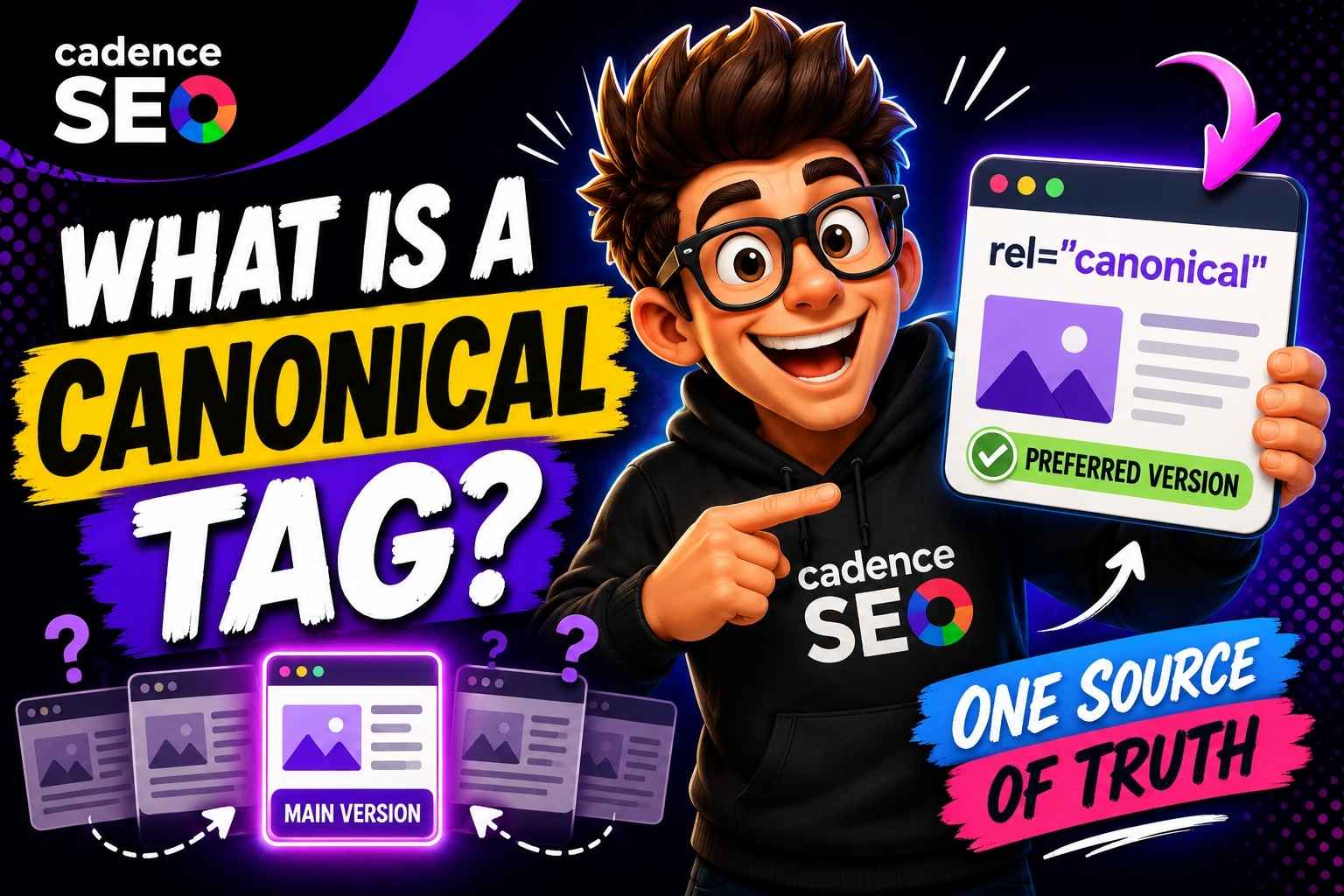
When you use a canonical tag, you’re signaling to search engines which URL should be treated as the primary or authoritative version of a page. Canonical tags, also known as “rel=canonical,” allow you to specify the canonical URL for a web page. This tells search engines which version you want indexed and displayed in search results, helping to consolidate ranking signals and avoid fragmentation. Canonical tags are placed in the <head> section of your web page’s HTML and typically look like this: https://www.cadenceseo.com/blog/demystify-seo-by-debunking-these-search-engine-optimization-myths/”/>Then, a canonical URL or link is the selected “master” URL for a set of duplicate pages. As Google described it, “a canonical URL is the URL of the page that Google thinks is most representative from a set of duplicate pages on your site.”However, even if you indicate your preferred URL, Google may still select a different version as the canonical page based on its own assessment of relevance and quality. You can use Google Search Console’s URL Inspection Tool to see which page Google currently considers the canonical page. In most cases, if your specified canonical URL is valid and accessible, Google will honor your preference. While canonical tags are the most common way to specify a canonical URL, there are alternative methods as well:
- Specifying the canonical pages in a sitemap
- Using 301 redirect
- Setting a rel=canonical header in your page response
Why Are Canonical Tags Still Important?
While there’s no official penalty for duplicate content, having multiple URLs with the same or similar content can create several SEO challenges. The more duplicate content search engines encounter, the greater the risk they’ll overlook some of your high-value pages. Extensive duplication can also dilute your site’s ranking potential. You might think duplicate content isn’t an issue for your site—especially if you’ve never intentionally published duplicates. However, it’s not always that simple. Content management systems (CMS) often generate multiple URLs for the same content, and some platforms automatically add tracking parameters or create alternate versions (e.g., mobile or print-friendly), which can result in unintentional duplicates. Here are some examples of URL variations that search engines may treat as duplicates, even though they display the same content:
- https://www.website.com/bluejeans/
- https://website.com/bluejeans/
- https://m.website.com/bluejeans/
- https://www.website.com/bluejeans
For example, the third URL is a mobile-friendly version. If you have separate mobile and desktop versions of the same content, it’s helpful to specify which URL is the canonical version for that page. Let’s look at some compelling reasons to prioritize canonicalization:
- Manage Syndicated Content: You may syndicate your content on other domains for publications. However, to ensure that the original piece is the one ranking in search engines, you could use canonical URLs.
- Facilitate Tracking Metrics for Singular Products or Topics: A variety of URLs makes it more difficult to obtain consolidated metrics for a given piece of content. Nonetheless, implementing canonical URLs simplifies this.
- Indicate the URL that Appears in Search Results: Keep things “clean” by specifying which URL version you want users to see in search results.
Think about it: you may prefer visitors to reach your page via https://www.website.com/bluejeans/ rather than https://website.com/womenclothes/jeans?gclid=ABCD.
What are Some Canonicalization Best Practices?
Duplicate content can hinder your SEO performance, but with canonical tags, avoiding these pitfalls is straightforward. Implementing canonical URLs is simple when you follow these updated best practices. So, keep reading!
Use Absolute URLs
If you want Google to consider your canonical tag, you need to use absolute URLs. Unlike relative URLs, absolute ones include the full URL with all of these parts:
- https://
- WWW
- The domain’s name
- The .com
So, a relative URL will look like this:<link rel=”canonical” href=”/bluejeans/” />. Having said that, you should be using the absolute one that looks like this:<link rel=”canonical” href=”https://www.website.com/bluejeans/” />
Utilize Self-Referencing Canonical URLs
If a page is not canonicalizing to another URL, you should integrate self-referencing canonical URLs. While this is not required, it helps, as the page will contain a canonical tag that links to itself.
Canonicalize across Domains
If you own and control two websites, you can utilize canonical tags across the two domains. For example, you might have a media company that publishes content across multiple sites. Thanks to canonicalization, you can choose which website you want to rank.
Ensure Your Canonical URL Is Accessible
This might seem obvious, but it is crucial to canonicalize only URLs with a 200 status code. The URLs should also be allowed by robots.txt.Moreover, you should be particularly careful if you use programs that create canonical tags dynamically. For example, some CMS platforms write a unique self-referencing canonical tag for each URL that is published on your website.
Specify Either WWW or Non-WWW URLs
You need to specify the correct version, as non-WWW URLs and WWW ones are regarded by search engines as duplicates.
Avoid Canonicalizing to Irrelevant Content
Remember our main principle- “quality over quantity”? Well, this also applies to canonical tags. That being said, not only is it useless to canonicalize URLs to content that is not near duplicates or identical, but it may also hinder your website’s credibility.
Keep Your Website Optimized with Modern Canonical Tag Strategies
Canonicalization remains fundamental for effective SEO and deserves to be a top priority in your digital strategy. Improper use of canonical tags can create more problems than they solve, but when implemented correctly, they’re invaluable for managing duplicate content. Give canonicalization the attention it deserves, and you’ll find it’s an accessible yet powerful tool.If you’re unsure where to start with canonical tags, CadenceSEO can help. Our team is dedicated to using white-hat SEO practices that elevate your site from ordinary to extraordinary. So, what are you waiting for? Contact us today for a free consultation!