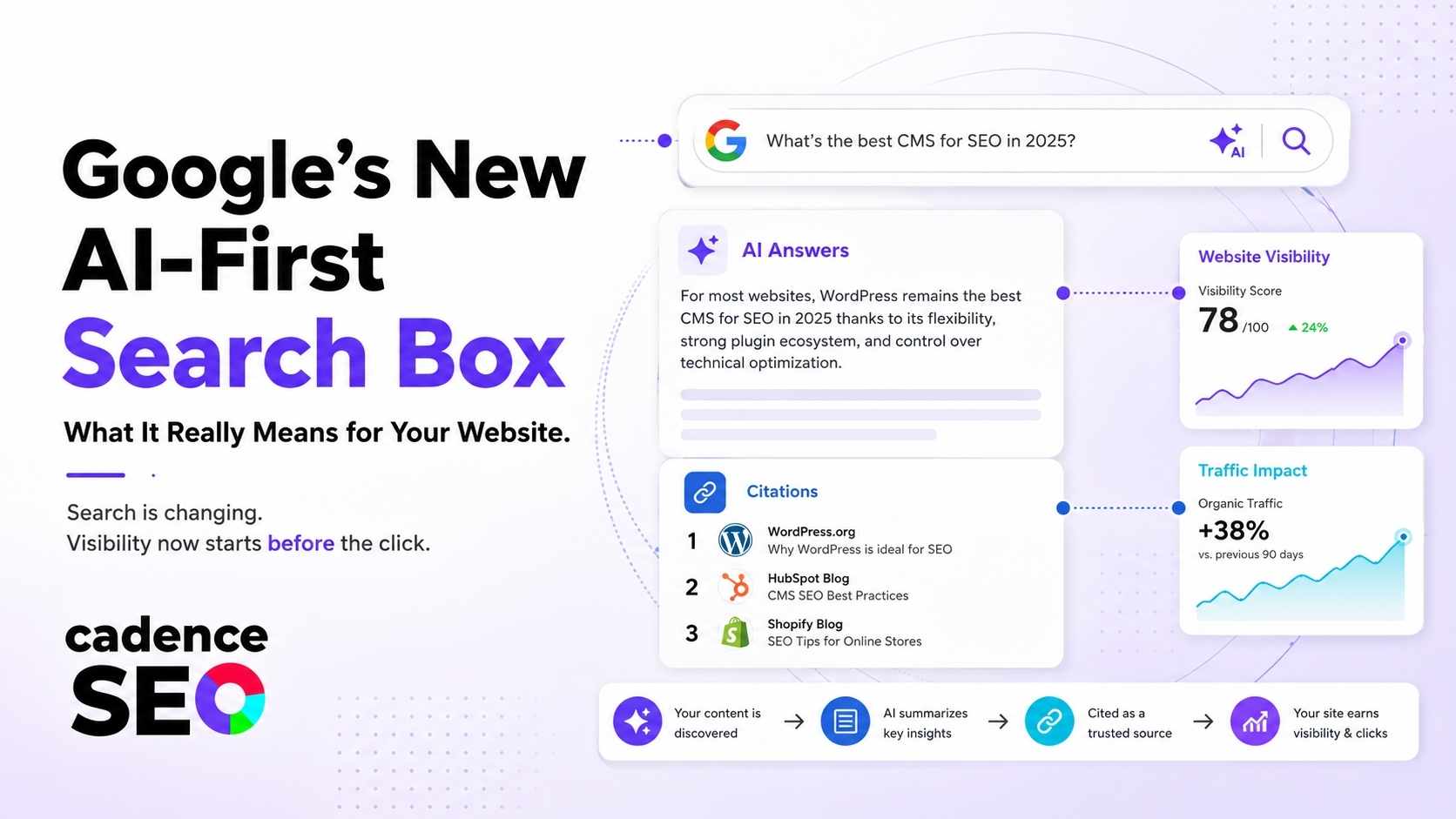
Google just rewired its front door. The search box users have been typing into for over two decades is becoming a Gemini-powered, AI-first interface that answers in longer, conversational responses, not just a list of blue links. For online businesses, that means the way customers find you is shifting. But there’s no cause for alarm. As long as you stick to creating high-quality content and hold true to proven SEO strategies, you’ll be just fine.
Google just rewired its front door. The search box users have been typing into for over two decades is becoming a Gemini-powered, AI-first interface that answers in longer, conversational responses, not just a list of blue links. For online businesses, that means the way customers find you is shifting. But there’s no cause for alarm. As long as you stick to creating high-quality content and hold true to proven SEO strategies, you’ll be just fine.
What’s Changing in Google’s Search Box
At Google I/O 2026, head of Search, Liz Reid, called the redesigned “intelligent Search box” the biggest upgrade to the box since its debut over 25 years ago. Instead of a static, fixed-width search bar, users will experience a much more dynamic, chatbot-style prompt box. The field now expands as you type, accepting text, images, files, videos, and even open Chrome tabs as inputs in the same query. It also offers AI-powered suggestions that go past plain autocomplete. Instead of just trying to finish your phrase based on what others searched, the new AI-generated suggestions try to anticipate what you actually mean, often with shortcuts to related AI tools right beneath the box.
Why Does the Search Box Change Matter?
The box runs on Gemini 3.5 Flash and lets people flow from an AI Overview into a back-and-forth conversation with AI Mode without leaving Google. Users can choose if they want to utilize AI Mode or not. The only exception is that if any input is non-text, AI Mode is automatically engaged.
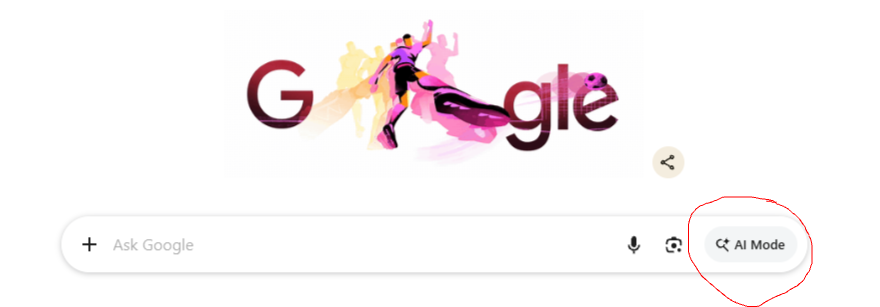
The big takeaway is that intelligent Search preserves context with any follow-up queries. That changes how people begin looking for answers, which is why this is a bigger deal than a typical feature update. Google believes most people simply don’t want to have to choose between traditional search and an AI-first approach. Now Google is giving them both, so they don’t have to.
The intelligent Search box began rolling out incrementally on May 19, 2026, in every country and language where AI Mode already exists, but availability varies by market, language, device, and account. It could mean you and your customers are seeing different versions of Google right now.
How an AI-First Search Box Changes User Behavior
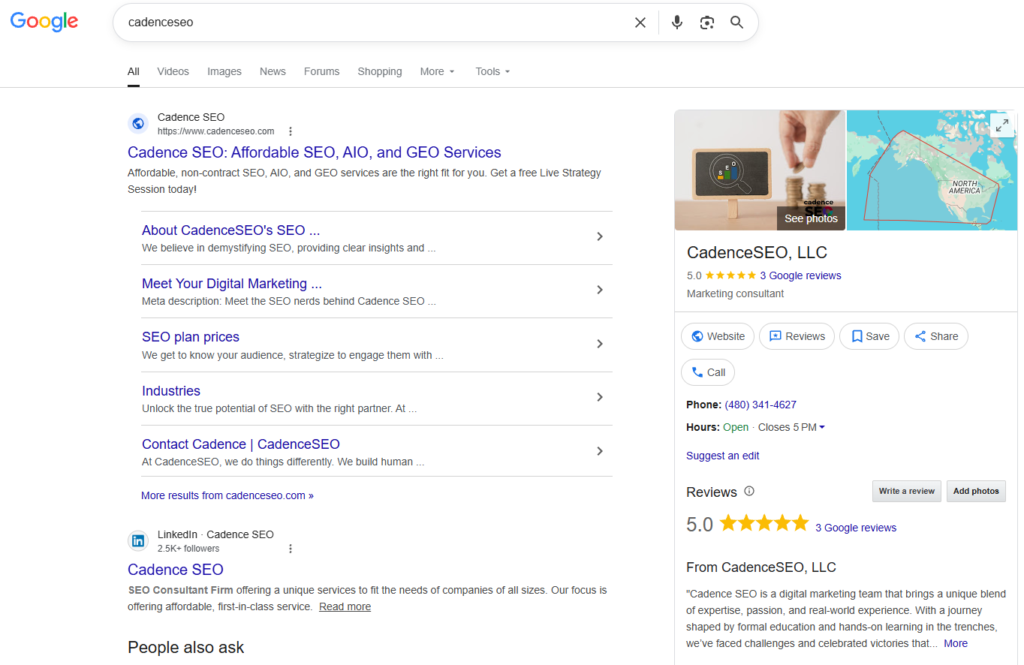
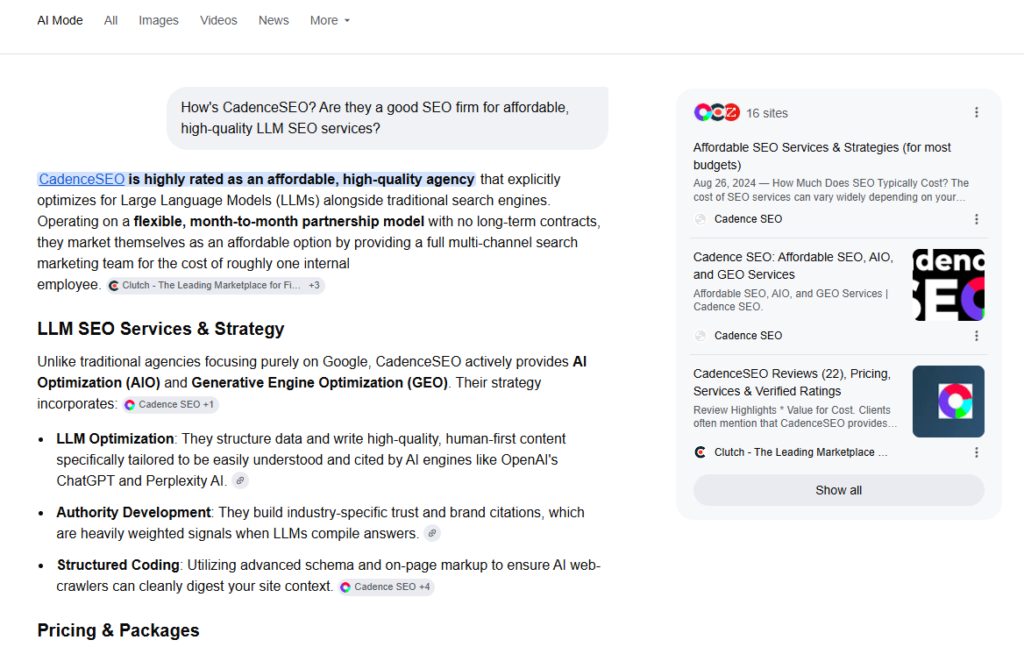
Now that Google answers conversationally through AI Overviews and AI Mode, users are being nudged toward longer, more nuanced, multi-part questions. We tested various search techniques and noticed that the box grows to fit conversational inputs, which invites prompts like “How’s CadenceSEO? Are they a good SEO firm for affordable, high-quality LLM SEO services?” instead of a keyword or two like “CadenceSEO.”
This is what we saw before the intelligent Search box update:
After the Intelligent Search Box Update:
Is the Shift to AI-First Search Good for SEO?
There are a lot of mixed feelings about AI in general, and it’s no different when it comes to SEO.
When users chat with Google now, they tend to stay inside the Google chatbot instead of clicking on a link to a website, all thanks to the AI-search box updates. That may be nice for users (and Google), but it can be frustrating for just about everyone else trying to generate traffic. Pew Research Center tracked 900 U.S. adults and found that when an AI summary appeared, people clicked a traditional search result only 8% of the time, versus 15% without one. Sessions also ended more often after an AI summary. So, intelligent Search can feel like it’s blocking the flood of traffic that could be heading to the rest of the web, including your site.
Is There Any Backlash to AI-Dominated Search from Users?
Google may have bet the future of search on AI with over 2 billion monthly users, but some aren’t so sure. Many users feel AI just overcomplicates things and takes too much control over search. For instance, analyzing user intent and deciding for the user what they actually want can feel like an invasion of privacy especially as it feeds off of data from search history. AI can be prone to hallucinations, offering inaccurate responses to unprompted queries. Intelligent Search can also turn queries into an unprompted personal conversation.
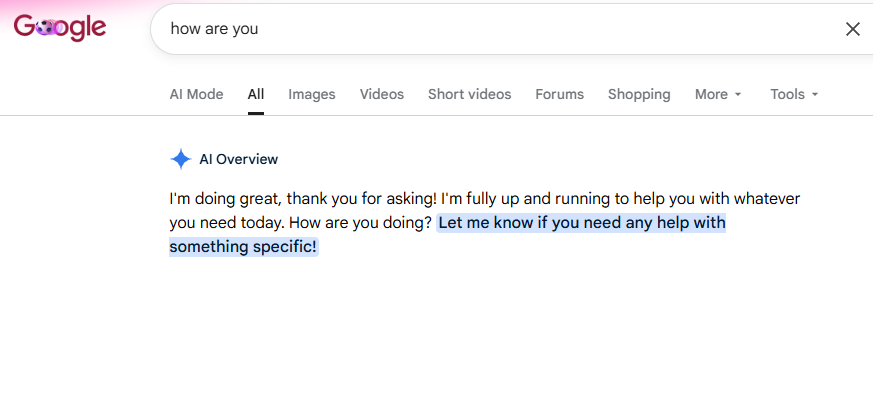
Users who don’t want to have AI forced on them can try AI-free search engine alternatives like DuckDuckGo. AI use is optional, which is not the case with Google’s intelligent Search. Even though DuckDuckGo has seen a 69% increase in app downloads since the AI search box announcement, they have a long way to go to break Google’s overwhelming dominance in search.
What This Means for Your SEO and Online Visibility
Because the rollout is staggered, expect uneven change across regions, devices, and audience segments rather than one clean before-and-after moment. Your dashboard may wobble in ways that have less to do with your site and more to do with who’s seeing which version of Google.
The good news is that staying true to SEO fundamentals is what helps online businesses weather any changes Google throws their way. Clear structure, good internal linking, crawlability, fast pages, and credible authority signals are what let Google trust and surface your content, AI layer or not. If you’ve been ignoring your technical SEO foundation, then this is the moment to fix it. Solid plumbing is what makes AI-mediated search (or any search, for that matter) work in your favor.
What’s new is the goal line. Visibility now includes whether your content is clear enough and structured enough to be quoted inside an AI-generated answer, not only whether you rank for blue links. Think topical authority and answer-first writing. Your content should lead with the direct response, then support it. That’s the heart of optimizing for LLMs, and it pairs naturally with classic/traditional SEO rather than replacing it.
How to Make Your Content AI-Friendly Without Starting From Scratch
The new era of Gemini dominating the search box and AI Overviews taking precedence over blue links doesn’t mean you need to scrap all of your content. It may just need some gentle retooling.
Structure for Skimming
Structure pages so a human and a machine both “get it” in seconds. Use clear headings, logical sections, and concise answers at the top. Content that’s easy to parse is easier for AI systems to reuse. Once you’ve set up the clear thesis for each section, you can dive into a deeper discussion so the content isn’t thin.
Answer Real Questions
Write for the real questions buyers ask. Build around the conversational, problem-shaped prompts people now type, not just exact-match keyword phrases. Different large language model (LLM) platforms reward slightly different signals, which is why it helps to know how to rank across each LLM. For instance, did you know that to show up on Claude, your site needs to be indexed by Brave? Like DuckDuckGo, Brave also offers optional AI search.
Cover the Technical Basics
It may not seem as glamorous, but getting under the hood of your site matters just as much. Make sure the technical side of your site is pulling its weight: clean crawlability, fast page performance, smart internal linking, and schema markup where it fits. Clarity in these areas feeds both discoverability and how well AI systems interpret your pages.
Stay Visible as Google Goes AI-First with CadenceSEO
CadenceSEO has guided clients through plenty of Google shifts, including the recent Spring 2026 updates, and we treat this one the same way. We separate the hype from the signal, then execute the fundamentals in our tried-and-true manner. Our team combines high-quality content creation with strong technical SEO and AI visibility services so your site is genuinely useful to readers and easy for search engines to interpret, in both traditional results and AI answers.
Want to know where you stand? Schedule a free consultation for a website checkup. We’ll review your current performance, flag AI-related search changes in your industry, and map the highest-impact strategy for your brand.
Resources:
- Google Search’s I/O 2026 updates: AI agents and more
- Gemini 3.5 Flash | Gemini API | Google AI for Developers
- Google AI Mode – a new way to search, whatever’s on your mind
- www.pewresearch.org/short-reads/2025/07/22/google-users-are-less-likely-to-click-on-links-when-an-ai-summary-appears-in-the-results/
- Google’s AI Overviews have 2B monthly users, AI Mode 100M in the US and India | TechCrunch
- noai.duckduckgo.com
- DuckDuckGo app download growth after Google Search overhaul 2026| Statista
- Search Engine Market Share Worldwide | Statcounter Global Stats
- Private Search Engine – Brave Search