

B2B SaaS marketing would be a lot easier if the buying process looked like this: someone finds your website, likes your software, books a demo, and buys.
Unfortunately, that’s rarely how it works.
A potential customer might discover your company through Google, compare you with several competitors, ask an AI assistant for recommendations, read reviews, check LinkedIn, visit your pricing page, disappear for three weeks, come back through a branded search, watch a demo, and finally talk to sales.
And the person doing all that research may not even be the person who signs the contract.
That’s what makes B2B SaaS marketing so different. You aren’t simply trying to generate traffic or collect leads. You’re building a system that helps the right companies discover you, understand you, trust you, choose you, and continue seeing value after the sale.
That requires more than one marketing channel and thinking beyond the traditional funnel.
What Is B2B SaaS Marketing?
B2B SaaS marketing is the process of attracting, educating, converting, retaining, and growing business customers for a Software-as-a-Service product.
The important part of that definition is everything that happens after attracting.
With many products, marketing can focus heavily on generating the initial sale. SaaS companies don’t have that luxury because recurring revenue changes the equation. You need customers to find the product, understand why it matters, buy it, successfully adopt it, continue using it, renew, and ideally expand their relationship with your company.
That means marketing can influence nearly every stage of the customer lifecycle:
- Discovery: Helping the right companies find your brand when they’re researching a problem or solution.
- Education: Giving buyers the information they need to understand their problem, your category, and your approach.
- Evaluation: Helping prospects compare options and feel confident putting you on the shortlist.
- Conversion: Turning qualified interest into trials, demos, sales conversations, and customers.
- Adoption: Helping new customers reach value quickly.
- Retention: Keeping customers engaged and reinforcing the product’s value.
- Expansion: Creating opportunities for additional seats, products, services, referrals, and advocacy.
Customer acquisition matters. But in SaaS, acquisition isn’t the finish line.
Why Is B2B SaaS Marketing Different?
Most SaaS buyers aren’t simply purchasing software. They’re changing the way some part of their organization works.
That creates questions—and usually a lot of them.
A potential customer may want to know:
- Will this actually solve the problem we’re experiencing?
- How difficult will implementation be?
- Will our employees use it?
- Does it integrate with our current technology?
- Is our data secure?
- How much will it really cost?
- Can we justify the investment?
- What kind of support will we receive?
- Will the platform still work as we grow?
- How is it different from the alternatives we’re considering?
The challenge is that those questions often come from different people.
The person who discovers your software may care most about fixing an immediate problem. Their manager may care about efficiency. IT might care about integrations and security. Finance wants to understand the economics. An executive wants to know whether the investment will produce a meaningful business result.
That’s one of the biggest differences between many B2B and consumer marketing decisions: you’re often marketing to a buying group rather than an individual.
Good SaaS marketing helps every important person in that group find the information they need to move the decision forward.
The Modern SaaS Buyer Doesn’t Follow a Perfect Funnel
Marketers love funnels because funnels make customer behavior look wonderfully organized.
Awareness.
Consideration.
Decision.
Customer.
Actual buyers are much messier.
Someone might discover your company through an organic search result, see one of your executives on LinkedIn two weeks later, ask an AI tool about solutions in your category, read a review, visit your website, compare you with another platform, check pricing, and disappear.
A month later, someone else from the same organization might book the demo.
That’s increasingly normal.
Your potential customers may research through:
- Traditional search engines
- AI-powered search experiences
- ChatGPT and other LLMs
- Software review platforms
- Reddit and professional communities
- YouTube
- Industry publications
- Podcasts and webinars
- Peer recommendations
- Your own website and product experience
The goal of modern B2B SaaS marketing isn’t to force everyone through the same path. It’s to make sure your company keeps showing up with useful information while buyers are figuring out what they need and who they trust.
Start With the Customer, Not the Channel
Before asking whether you need more SEO, LinkedIn ads, video, paid search, webinars, or AI search optimization, answer four more important questions:
- Who are your best-fit customers? Go beyond descriptions like “mid-market businesses” or “marketing teams.”
- What triggers the search? Something usually happens before someone starts looking for new software.
- Who participates in the decision? Identify users, champions, influencers, budget owners, and potential blockers.
- What outcome are they really buying? Your product is the mechanism. The business result is what matters.
Once you understand those things, your channel strategy becomes much clearer.
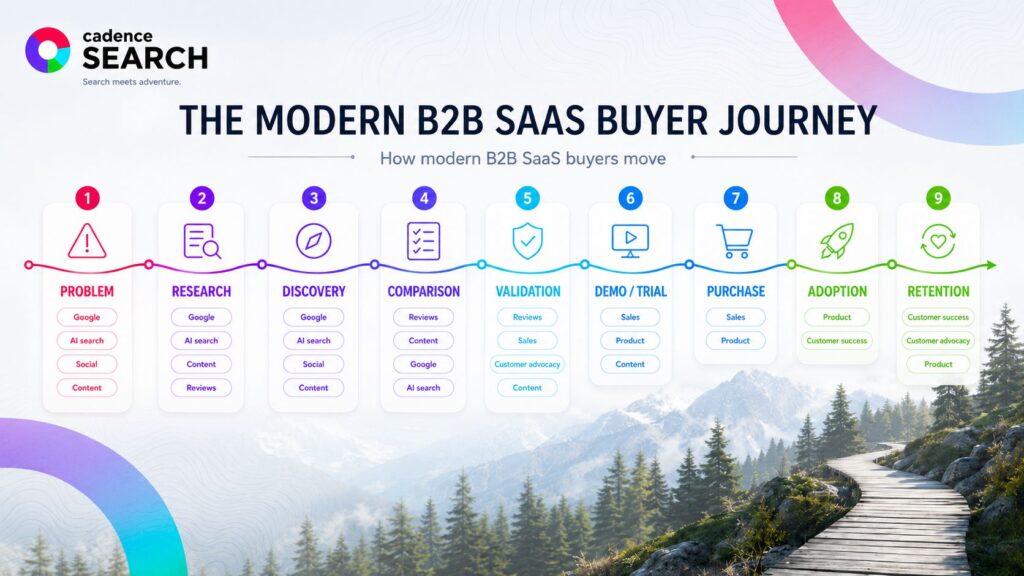
Build Your SaaS Marketing Strategy Around Buyer Intent
One of the easiest mistakes SaaS companies make is starting with tactics.
“Let’s publish more blogs.”
“Let’s spend more on paid search.”
“We need to do something with AI.”
Those statements start with a channel rather than a customer need.
Instead, start with the problems buyers are trying to solve and how their questions change as they get closer to a purchase.
Get the Messaging Right First
SaaS companies naturally love talking about features. A lot of work went into building them.
Your buyer cares about those features too—but usually because of what they enable.
Maybe your automation feature saves the team 15 hours every week. Perhaps your reporting platform finally gives leadership the visibility they’ve been asking for. Maybe your software eliminates errors, replaces three disconnected tools, shortens a sales process, or helps the company generate more revenue.
That’s the story.
Strong SaaS positioning connects four things:
Problem → Solution → Outcome → Proof
A potential customer should be able to quickly understand what you solve, who you solve it for, why your approach is different, and why they should believe you.
If your homepage could describe you and six of your competitors equally well, more traffic probably won’t solve the problem.
Understand Search Intent Across the Buying Journey
Search behavior changes as buyers move closer to a decision.
Someone at the beginning of their research may not even know what type of software they need. Someone near the end may be comparing two vendors and researching implementation details.
Good keyword research should identify these stages instead of simply producing a spreadsheet of high-volume phrases.
For example:
- Problem-aware: “How to automate client reporting”
- Category: “Best client reporting software”
- Use case: “Reporting software for digital agencies”
- Industry: “Reporting software for healthcare companies”
- Comparison: “Platform A vs Platform B”
- Alternative: “Platform A alternatives”
- Integration: “Reporting software that integrates with HubSpot”
- Decision stage: Pricing, security, onboarding, migration, support, reviews, and contract questions
These searches don’t have equal business value.
A broad informational phrase may generate thousands of visitors and very little pipeline. A highly specific comparison or integration search may generate considerably less traffic but consistently reach people who are actually evaluating software.
That’s why traffic shouldn’t be the sole objective of a B2B SaaS search strategy.
The goal is not simply more traffic. It’s more of the right people discovering you at the right moment.
For a deeper breakdown of the organic side of this strategy, our complete guide to SEO for SaaS covers keyword strategy, content, technical SEO, authority, and measurement in greater detail.
Search Is Bigger Than Rankings Now
SEO still matters.
A lot.
But modern search behavior extends beyond a page of traditional Google results.
Buyers can now move between traditional organic results, AI-powered search experiences, conversational AI, social platforms, communities, review sites, video, and other sources during the same research process.
Google itself now describes AI Overviews and AI Mode as part of the broader search experience and says that its foundational SEO best practices continue to apply to these generative experiences. Google does not require a separate special markup or a set of technical tricks to appear in them.
You may hear marketers use terms such as:
- AI SEO
- Answer Engine Optimization (AEO)
- Generative Engine Optimization (GEO)
- LLM optimization
- AI search optimization
- AI visibility
Those labels can be useful when describing different areas of focus, but don’t let the terminology make the strategy more complicated than it needs to be.
The real question is:
Can your brand be found, understood, and trusted when a potential customer goes looking for an answer?
For SaaS companies, modern search visibility includes several connected areas:
- Organic visibility: Do you appear for the problems, categories, use cases, comparisons, and questions buyers search?
- AI visibility: Can AI-powered search experiences discover and accurately understand your brand and expertise?
- Content authority: Does your website demonstrate real depth around the problems your product solves?
- Third-party authority: Are credible publications, customers, communities, and industry sources talking about you?
- Entity clarity: Is it easy to understand who your company is, what your product does, and who it’s for?
- Technical accessibility: Can search engines crawl, render, index, and interpret important content?
The technical foundation still matters. Technical SEO helps ensure that important pages are accessible and understandable before you invest heavily in getting more people to find them.
And for companies specifically evaluating how they appear across AI-driven discovery experiences, LLM optimization can help broaden the conversation beyond traditional rankings.
Don’t Chase AI Search Hacks
Whenever search changes, shortcuts appear.
The current AI-search conversation is no exception.
Google’s current guidance emphasizes the same fundamentals that have supported strong search performance for years: accessible websites, useful organization, strong user experiences, original information, and content that provides genuine value. It specifically recommends prioritizing unique, non-commodity content over material that simply repackages what already exists online.
That should be reassuring.
You don’t need to completely reinvent your content strategy every time a new acronym becomes popular.
You do need to become harder to replace.
Create SaaS Content That Actually Helps Someone Buy
The internet doesn’t need another generic article titled “10 Ways to Improve Productivity.”
AI has made average informational content easier than ever to create, which means publishing more content by itself isn’t much of a competitive advantage.
The better question is:
What can your company publish that genuinely deserves to exist?
A strong SaaS content strategy should help potential buyers solve problems while reinforcing the subjects your company wants to be known for.
That can include:
- Original research and proprietary data that contribute something new.
- Expert education from people inside your company who understand the industry.
- Detailed product comparisons that help buyers understand meaningful differences.
- Industry-specific use cases that show how your solution applies across different environments.
- Implementation and migration guides that reduce uncertainty.
- Pricing and ROI resources that help champions build an internal business case.
- Templates, calculators, tools, and frameworks that offer utility rather than just information.
- Integration content that answers practical evaluation questions.
- Product videos and demonstrations that let buyers understand the experience.
- Case studies that provide evidence behind your claims.
Google’s current generative-AI guidance specifically encourages content that brings a unique experience, expertise, original information, and useful visual or multimedia elements rather than simply recreating commodity information available elsewhere.
The goal is to make your potential customer smarter.
Even better, you want them to finish your content thinking:
“These people really understand the problem we’re trying to solve.”
Comparison Content Is Especially Valuable
SaaS companies are sometimes uncomfortable talking about competitors.
Your customers aren’t.
They’re comparing you whether you participate in the conversation or not.
That’s why content around queries like these can be so valuable:
- Your Product vs. Competitor
- Competitor Alternatives
- Best Software for a Specific Use Case
- Best Software for a Specific Industry
- Your Product vs. Doing It Manually
- Your Product vs. Building Internally
Before creating that content, a B2B competitive analysis can help identify how competitors position themselves, which topics they already own, and where buyers may still have unanswered questions.
The important part is being useful rather than pretending every competitor is terrible.
If another platform really is a better fit for a particular kind of company, say so. Being willing to acknowledge that can make the rest of your comparison much more credible.
Your goal shouldn’t be to convince every company that you’re the answer.
Your goal should be to help the right companies realize that you are.
Case Studies Need to Tell an Actual Story
“We increased efficiency and loved working with the team.”
That’s nice.
It just doesn’t tell a buyer very much.
Strong SaaS case studies answer questions such as:
- What was happening before?
- Why had the problem become important?
- What had the customer already tried?
- Why wasn’t the previous approach working?
- Why did they choose this solution?
- What did implementation involve?
- What changed?
- What measurable result did they achieve?
Specificity builds credibility.
It also gives search engines, AI systems, sales teams, and potential customers more context around what you actually do well.
Cadence Search’s own B2B SaaS growth case study is one example of using a customer story to connect the initial problem, strategy, implementation, and measurable outcome rather than relying on a short testimonial.
Is Your SaaS Brand Showing Up Where Buyers Are Looking?
Traditional rankings are only one part of modern search visibility.
If you want to understand where your company is performing well, where competitors are gaining ground, and where opportunities may be getting missed, request a free video audit from Cadence Search.
We’ll identify practical opportunities across search, content, technical performance, authority, and buyer discovery.
Demand Generation Is Bigger Than Lead Generation
Here’s another idea worth challenging:
A form submission does not automatically equal demand.
Someone downloading an ebook may have absolutely no intention of buying your software.
Meanwhile, another prospect might read three articles, visit your product pages, check pricing, watch a demo, search for reviews, compare you with a competitor, come back directly two weeks later, and never fill out a traditional marketing form until they’re ready to speak with sales.
Which prospect would you rather have?
B2B SaaS demand generation is about creating awareness, trust, and preference among the companies you actually want to win.
Sometimes that means capturing existing demand.
Other times it means creating it.
A strong mix might include:
- SEO and paid search to capture active demand.
- Thought leadership to shape how the market thinks about an issue.
- Digital PR and earned media to increase authority and reach.
- Video, webinars, and podcasts to educate in different formats.
- Social and executive visibility to create familiarity.
- Partnerships and communities to reach audiences through trusted relationships.
- Customer advocacy to provide third-party proof.
- Retargeting and lifecycle campaigns to stay relevant during a longer consideration process.
Digital PR can be especially useful when it connects genuine expertise, research, data, and strong stories with the publications and communities buyers already trust.
Not every valuable interaction will fit neatly into a last-click attribution model.
That doesn’t mean it didn’t influence the sale.
Let the Product Do Some of the Marketing
One advantage SaaS businesses have is that the product itself can sometimes become part of the customer acquisition strategy.
Depending on the product, that might include:
- Free trials
- Freemium plans
- Interactive product demos
- Sandboxes
- Product tours
- Free calculators
- Templates
- Assessments
- Limited free tools
These experiences shorten the distance between “I think I understand what this software does” and “Now I can see why this would help us.”
That doesn’t mean every SaaS company should become completely product-led.
A complex enterprise solution may still require a high-touch sales process. Other companies may use a hybrid model where marketing generates demand, the product creates initial engagement, and sales helps larger accounts complete the decision.
The right mix depends on the product, audience, price point, sales cycle, and implementation complexity.
What matters is that marketing, sales, product, and customer success feel like parts of the same experience.
Because that’s how your customer sees them.
A Simple Framework for Modern SaaS Growth
There are dozens of channels, hundreds of metrics, and an endless supply of marketing tactics to choose from.
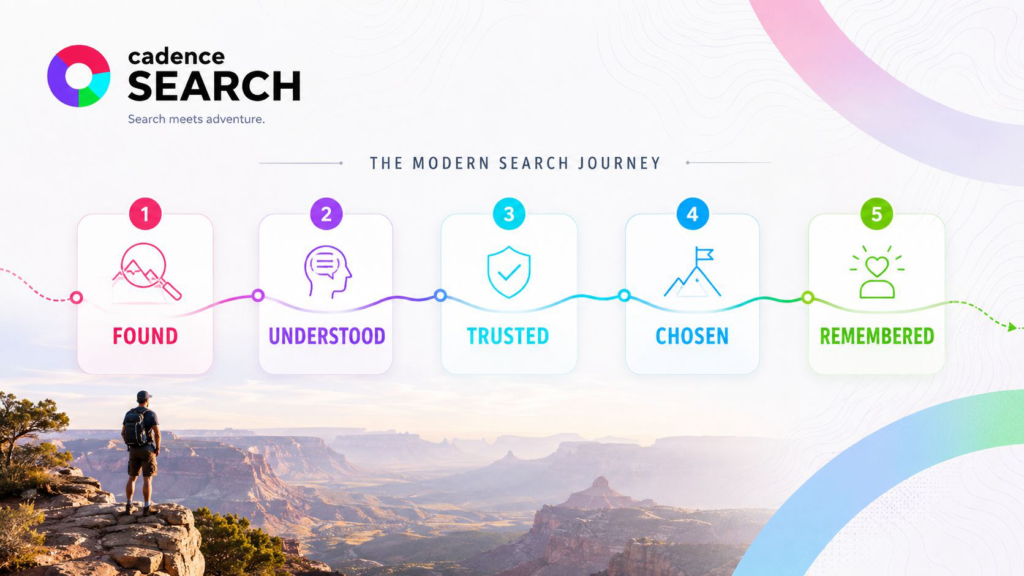
A simpler way to think about B2B SaaS marketing is through five outcomes:
1. Be Found
Your ideal customers need to discover you.
That may happen through Google, AI search, social media, industry content, paid campaigns, communities, recommendations, podcasts, events, or another channel.
The first job of marketing is visibility.
2. Be Understood
Being visible doesn’t help much if the customer can’t quickly figure out what you do.
Your positioning, messaging, website architecture, product pages, content, and external brand signals should make the answer clear.
What problem do you solve?
Who do you solve it for?
Why does your approach matter?
3. Be Trusted
B2B buyers take a risk when selecting software.
Trust comes from customer stories, expert content, reviews, case studies, authoritative mentions, strong product experiences, transparent information, and consistency across the places where people encounter your brand.
Visibility gets attention.
Trust gets you considered.
4. Be Chosen
Eventually, the buyer has to make a decision.
Your product experience, comparison content, sales process, pricing, proof, integrations, implementation resources, security documentation, ROI materials, and positioning all help answer one question:
Why this solution?
5. Be Remembered
The relationship doesn’t end when the contract is signed.
Great onboarding, education, support, customer marketing, product communication, and ongoing value turn buyers into long-term customers—and long-term customers into advocates.
In other words:
Be Found → Be Understood → Be Trusted → Be Chosen → Be Remembered
That framework also provides a useful way to evaluate your marketing strategy.
If growth is struggling, ask where the breakdown is happening.
Are enough ideal customers finding you?
Do they understand you?
Do they trust you?
Are they choosing competitors instead?
Or are you acquiring customers but failing to retain them?
The answer can tell you much more than another dashboard full of traffic numbers.
Measure SaaS Marketing by Business Outcomes
Marketing teams have access to more data than ever.
That doesn’t mean every metric deserves equal attention.
Traffic matters.
Rankings matter.
Engagement matters.
AI search visibility matters.
Leads matter.
But none should exist in isolation.
Depending on your SaaS model, the metrics worth connecting back to marketing can include:
- Qualified pipeline
- Demo conversion rate
- Trial conversion rate
- Trial-to-paid conversion
- Marketing-sourced revenue
- Marketing-influenced revenue
- Customer acquisition cost (CAC)
- CAC payback period
- Customer lifetime value (LTV)
- Activation rate
- Churn
- Expansion revenue
- Net revenue retention (NRR)
Search metrics still matter because they help you understand visibility and diagnose performance.
The mistake is treating the search metric as the business result.
If organic traffic drops 10% but qualified organic pipeline increases 35%, most SaaS leadership teams aren’t going to lose much sleep over the traffic graph.
Context matters.
AI-search measurement is also becoming more tangible. In June 2026, Google began testing dedicated Search Console reporting for visibility within generative search features such as AI Overviews and AI Mode, alongside the broader performance reporting already available.
As measurement evolves, SaaS teams should resist creating disconnected reporting silos for “SEO,” “AI,” “content,” and “brand.”
The better question is how those activities are contributing to discovery, consideration, pipeline, and revenue.
Retention Is Marketing Too
Marketing’s job doesn’t end when a deal closes.
For a recurring-revenue company, thinking that way gets expensive quickly.
Customer marketing can influence adoption, retention, expansion, referrals, and advocacy through things like:
- Better onboarding
- Customer education
- Product webinars
- Newsletters
- Training
- Feature announcements
- Community programs
- Customer events
- New-use-case campaigns
- Case studies
- Advocacy and referral programs
A customer who consistently receives value is more likely to renew, purchase additional products or seats, refer another company, leave a positive review, participate in a case study, and publicly advocate for your brand.
Those activities also feed acquisition.
The great customer story becomes a case study.
The happy user becomes a reviewer.
The customer expert joins your webinar.
The successful implementation becomes proof for the next buying committee.
Some of your best future marketing may already be sitting inside your existing customer base.
What Should a SaaS Company Prioritize First?
One of the problems with a comprehensive marketing guide is that everything can start to sound important.
It is.
But not everything needs to happen at once.
If you’re building or refreshing a B2B SaaS marketing strategy, start by getting these pieces right:
- Clarify the ICP and buying group. Know who you’re trying to win and who participates in the decision.
- Sharpen the positioning. Make the problem, audience, outcome, and differentiation easy to understand.
- Map the buyer journey. Identify the questions customers ask from initial problem awareness through final evaluation.
- Audit existing visibility. Understand where you appear today across organic search, AI search, third-party sources, and important category conversations.
- Fix the foundation. Resolve technical, architecture, messaging, and conversion issues before simply adding more traffic.
- Build content around real buyer needs. Prioritize category, use-case, comparison, integration, proof, and decision-stage content alongside educational resources.
- Strengthen external authority. Earn relevant mentions, links, reviews, customer advocacy, and industry visibility.
- Connect marketing to the pipeline. Decide how you’ll measure qualified opportunities and business outcomes—not just traffic.
- Improve the customer experience after the sale. Acquisition becomes much more valuable when retention is strong.
- Review and improve continuously. Buyer behavior, competitors, products, and search experiences change. Your strategy should, too.
You don’t need to be everywhere.
You need to be where your customers matter, with something worth finding when they get there.
What Does a Great B2B SaaS Marketing Strategy Look Like?
A great SaaS marketing strategy isn’t necessarily the one using the most channels.
It’s the one with the most clarity.
You know who your best customers are.
You understand what causes them to start looking.
You know the problems they’re trying to solve, the questions they ask, the people involved in the decision, the alternatives they consider, and the proof they need before moving forward.
Then you build a connected marketing ecosystem that makes those answers easy to find.
Your customer may find you through Google.
They may encounter you in an AI-generated response.
They may see an executive discussing the issue on LinkedIn.
They may discover your research in an industry publication.
They may watch a customer interview.
They may see your name repeatedly as they research the category.
Or they may simply ask a colleague:
“Have you heard of these guys?”
And hopefully the answer is:
“Yes.”
That’s what strong visibility ultimately looks like.
B2B SaaS Marketing Is About Being the Right Answer
B2B SaaS marketing isn’t about getting as many eyeballs as possible on your software.
It’s about being discovered by the right people, earning enough trust to make them want to learn more, giving them enough confidence to choose you, and delivering enough value that they’re glad they did.
Search plays an important role in that journey, but modern search extends far beyond rankings.
Your buyers are researching through traditional search engines, AI-powered experiences, LLMs, publications, review sites, communities, social platforms, videos, and peer recommendations. The brands that succeed will be the ones that understand how those experiences connect.
At Cadence Search, that’s how we think about search visibility.
We help B2B and SaaS companies understand where their customers are searching, where the brand is already visible, where competitors are winning attention, and what needs to change to create sustainable growth.
Our SaaS search and marketing services connect technical SEO, content, keyword strategy, digital authority, AI visibility, and LLM optimization around the way real buyers research and make decisions.
Because the objective isn’t simply more traffic.
It’s to be found, be understood, be trusted, be chosen, and be remembered.
If you want to see where your SaaS brand stands today, request a free video audit.
We’ll show you what’s working, where visibility is being lost, and which opportunities we’d prioritize next.
Frequently Asked Questions About B2B SaaS Marketing
What is B2B SaaS marketing?
B2B SaaS marketing is the process of attracting, educating, converting, retaining, and growing business customers for a Software-as-a-Service product. It can include search marketing, content, demand generation, product marketing, paid acquisition, social media, customer marketing, digital PR, and product-led growth.
What are the best B2B SaaS marketing strategies?
The right strategy depends on your product, audience, pricing, sales cycle, and growth model. For many B2B SaaS companies, the strongest approach combines clear positioning, search visibility, high-intent content, demand generation, customer proof, product marketing, digital authority, paid acquisition, product-led experiences, and lifecycle marketing.
How is B2B SaaS marketing different from traditional marketing?
B2B SaaS companies often have longer buying cycles, multiple stakeholders, recurring revenue models, technical evaluation requirements, and a need to retain and expand customers after the initial purchase. As a result, marketing needs to support the entire customer lifecycle rather than focusing only on generating the first sale.
Why is SEO important for B2B SaaS?
SEO helps SaaS companies appear while potential customers are researching problems, product categories, competitors, alternatives, integrations, use cases, pricing, and other purchase-related questions. A strong SaaS SEO strategy focuses on reaching qualified buyers throughout the decision process rather than maximizing traffic alone.
How is AI changing B2B SaaS marketing?
AI is adding new ways for buyers to research problems, understand product categories, discover vendors, and compare options. At the same time, traditional search, third-party sources, customer reviews, and authoritative content remain important inputs into how brands are discovered and evaluated.
For Google’s generative search experiences specifically, Google says the fundamentals of SEO remain applicable and that no separate schema or AI-specific markup is required.
What is AI search optimization?
AI search optimization is a broad term for improving a brand’s visibility and representation within AI-powered search and discovery experiences. Depending on the platform, the work may overlap with technical SEO, content strategy, entity clarity, digital authority, third-party mentions, original research, structured information, and traditional search optimization.
What is LLM optimization for SaaS companies?
LLM optimization focuses on improving how a company, product, expertise, and content are understood and surfaced by large language model-driven experiences. For SaaS companies, this can include strengthening useful content, brand clarity, external authority, product information, expert attribution, and the wider ecosystem of sources associated with the business.
What B2B SaaS marketing metrics should companies track?
Important metrics may include qualified pipeline, demo or trial conversion, customer acquisition cost, CAC payback period, customer lifetime value, activation, trial-to-paid conversion, churn, expansion revenue, and net revenue retention. Traffic, rankings, impressions, engagement, and AI visibility are useful supporting metrics, but they should ultimately connect back to business outcomes.
What’s the difference between SaaS marketing and SaaS SEO?
SaaS marketing covers the broader strategy for creating awareness, demand, conversion, retention, and growth. SaaS SEO is one component of that strategy focused specifically on organic search visibility and discovery. SEO can support multiple stages of the SaaS buyer journey, but it works best when connected to positioning, content, demand generation, product marketing, authority, and conversion.
Should SaaS companies optimize separately for Google and AI search?
Companies should understand how their visibility differs across platforms, but the strategies shouldn’t operate in complete isolation. Strong technical foundations, original and useful content, clear positioning, authoritative third-party signals, relevant internal linking, and a strong brand presence support discoverability across the broader search ecosystem. For Google specifically, its current guidance says established SEO best practices remain foundational to its generative search experiences. Only from B2C, due to the vast differences among audience members. Our team of SEO nerds can help your enterprise identify your target audience and implement a wide range of SEO tools and techniques to help increase your brand’s online presence. If you’re ready to get started, contact us for a free consultation today!